BMW Marks 50 Years of Motorcycle Helmets
BMW Motorrad is celebrating 50 years of BMW helmets, tracing a line from its first full-face helmet in 1975 to the new eighth-generation System 8 and System 8 Carbon helmets scheduled for launch in May 2026, while highlighting five decades of development in rider safety, comfort, aerodynamics, ventilation, visibility, and integrated communication.
For sport touring riders, the milestone is relevant beyond the helmet itself. BMW remains one of the premier manufacturers of sport touring motorcycles, with a broad lineup that gives riders choices across touring, adventure touring, sport touring, and road-focused platforms. That makes BMW’s long-running investment in helmet development part of a larger rider ecosystem built around long-distance comfort, safety, and performance.
From BMW’s First Helmet to the System Series
BMW introduced its first helmet in 1975, working with Römer on a lightweight full-face design made from glass-fiber-reinforced plastic. The helmet weighed 1,400 grams and included a double-secured fastening system, leather interior, removable draught-deflecting chin guard, clear and sun visors, a large field of vision, and reflective elements for improved visibility in traffic.
The first BMW System Helmet followed in 1981. Its defining feature was a removable chin section, allowing the helmet to be converted into different configurations. BMW says that flip-up and removable chin-section concept has been continuously refined over the decades and now reaches its eighth generation with the System 8 and System 8 Carbon helmets.
Five Decades of Safety and Comfort Development
BMW’s historical review shows a steady progression of helmet technology. The 1985 System Helmet II added wind-tunnel-optimized aerodynamics, reduced turbulence and wind noise, and introduced an air-channel system intended to provide fresh air without draughts while helping prevent visor fogging. The 1989 System Helmet III brought ECE 22-03 compliance, improved aerodynamics, reduced wind noise, adjustable ventilation, and an anti-fog visor.
The System Helmet 4, introduced in 1997, used a shell made from a composite of glass fiber, Kevlar, and carbon. BMW followed with the System Helmet 4 EVO in 2001, which it says was the first BMW helmet to meet the ECE 22-05 safety standard, including testing of the chin section. The System Helmet 4 Elite, also presented in 2001, used carbon fiber and Kevlar to reduce weight by about 180 grams.
In 2005, BMW introduced the System Helmet 5, which added an integrated Bluetooth communication system. BMW says the system enabled wireless rider-to-rider communication at speeds exceeding 150 km/h. The helmet also used a segmented EPS inner shell, adjustable ventilation, a one-handed chin-section mechanism, and a removable Coolmax interior.
The System Helmet 6 arrived in 2009 with a continuously adjustable integrated sun visor, a four-joint mechanism, and a listed weight range of 1,570 to 1,670 grams. BMW says the helmet produced a noise level of 86 dB(A) at 100 km/h, placing it among the quietest flip-up helmets of its time. The 2013 System Helmet 6 EVO further refined the design, with BMW describing it as one of the safest and most comfortable flip-up helmets on the market at the time.
BMW unveiled the System Helmet 7 Carbon in 2016 for the 2017 motorcycle season. Its full-carbon shell reduced weight while further enhancing safety, and the helmet was prepared for integration with the BMW Motorrad communication system. BMW later developed the model into the System Helmet 7 Carbon EVO in 2021, with optimizations to aerodynamics and the visor mechanism.
System 8 Brings the Line to Its Eighth Generation
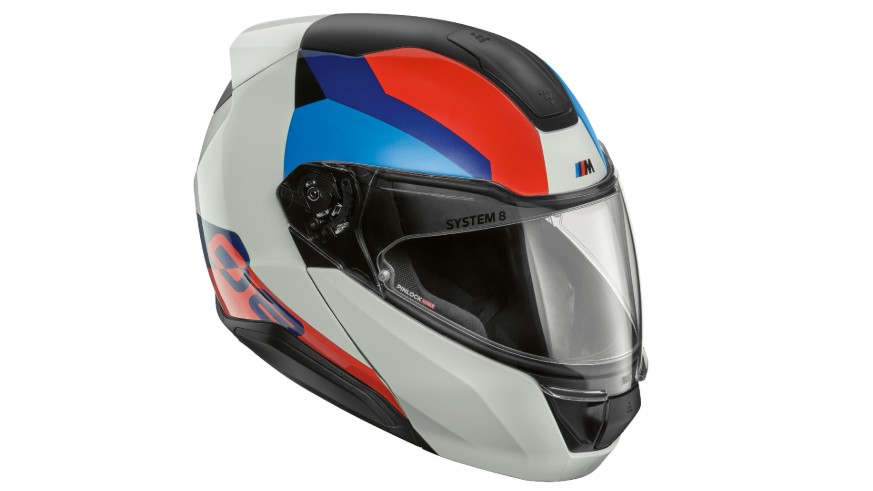
The current milestone leads to the BMW System Helmet 8 and System Helmet 8 Carbon, part of the BMW Motorrad Clothing Collection 2026. Both helmets are certified to ECE 22-06. The System Helmet 8 Carbon uses a carbon-aramid-glass-fiber composite shell, while the System Helmet 8 uses a glass-fiber-aramid composite shell. BMW says both deliver strong impact absorption and overall safety performance.
The System Helmet 8 Carbon also includes MIPS Integra TX, which BMW says is intended to reduce rotational head movement in an impact and lower injury risk. Both System 8 helmets use a multi-joint mechanism that keeps the helmet compact when flipped open, and both are approved for riding in the open position. BMW also cites optimized aerodynamics and aeroacoustics, a large spoiler, a dual-pane visor with Pinlock 200 anti-fog inner lens, scratch-resistant coating on both sides of the outer visor, an integrated sun visor, and optional BMW ConnectedRide COM P1 communication system compatibility.
Availability
BMW says the System Helmet 8 and System Helmet 8 Carbon will be available in ten graphics and color options, with market launch planned for May 2026.
Was this article helpful?
Thank you for your feedback!
Please email the editor with any additional comments.
Your feedback is used only by American Sport Touring. We do not store or sell your information.
Please read our Privacy Policy.