EV Cannonball Run Crosses America in 100 Hours
This article is based on Aaron Pufal’s firsthand account, “EV Cannonball Run in 100 Hours,” published by ADV Cannonball and used with permission.
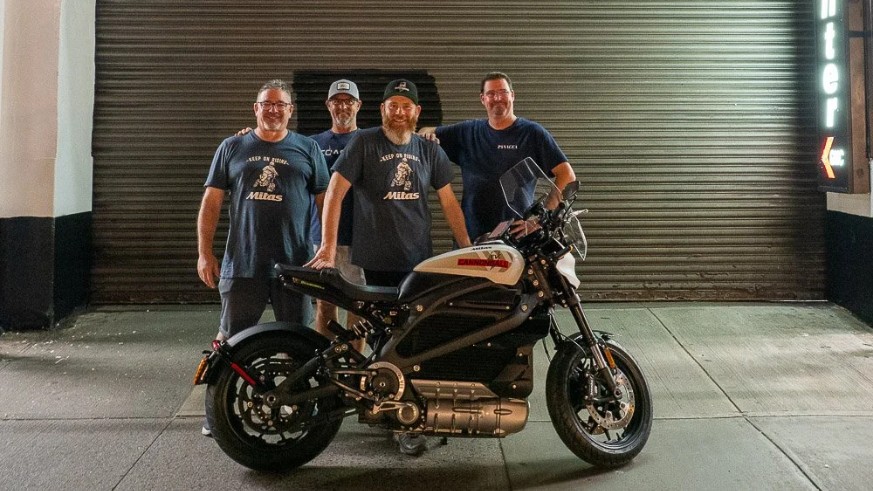
Aaron Pufal has completed a coast-to-coast motorcycle run on a 2021 Harley-Davidson LiveWire One, covering 2,959 miles from New York City to Los Angeles in an official elapsed time of 100 hours and 17 minutes.
The August 2026 run required 47 DC fast-charging stops and presented a different set of challenges from those typically associated with long-distance motorcycle travel. Pufal and his support team had to manage not only route, weather and rider fatigue, but also energy consumption, charger availability and increasingly difficult battery temperatures as they crossed the country.
Pufal began the run at midnight August 1 from New York’s Red Ball Garage, the traditional starting point for modern Cannonball attempts. Remarkably, he had never ridden the LiveWire One, or any electric motorcycle, before starting the trip.
The first part of the ride quickly demonstrated how heavily riding speed affected available range. After initially consuming energy at roughly 190 watt-hours per mile while riding at highway speeds, the team began experimenting with different speeds and riding techniques. Their testing eventually produced a target consumption rate of 109 watt-hours per mile while riding at approximately 65 mph behind the support van.
But efficiency proved to be only part of the equation.
Heat Becomes the Limiting Factor
As the run moved west, repeated fast charging combined with high ambient temperatures created an increasingly difficult thermal-management problem.
According to Pufal, battery temperature ranged from about 79 degrees to as high as 118 degrees after repeated charging sessions. A cool battery could accept as much as 20 kW of charging power, while an overheated battery could throttle charging to approximately 5 kW. That dramatically increased the time needed at charging stops.
Conditions became particularly difficult through Utah, Nevada and California, where Pufal reported temperatures reaching 113 degrees along with wildfire smoke.
The experience highlights an important distinction for riders considering electric motorcycles for extended travel. Nominal battery range is only one part of the long-distance equation. Charging speed, battery temperature and the availability and reliability of charging infrastructure can be just as important when covering hundreds of miles in a day.
Charging infrastructure itself presented another challenge. Pufal reported encountering poorly documented or unreliable charging stations along the route, while other locations provided recent usage information that gave the team greater confidence in arriving with very little battery capacity remaining.
The strategy evolved accordingly. Some charging stops were only about 45 miles apart, while other riding segments approached 100 miles.
A Different Kind of Long-Distance Ride
The run also retained many of the challenges familiar to anyone traveling long distances by motorcycle.
Pufal encountered heavy rain and lightning early in the trip, rough pavement, mountain crossings, extreme desert heat and accumulated fatigue. Charging stops, rather than providing opportunities for rest, became working stops used to plan the next leg, check charging options, recharge communications equipment, eat and hydrate.
A support crew coordinated routing, charging strategy and energy calculations throughout the crossing.
The LiveWire itself completed the trip without what Pufal described as a significant mechanical problem, although extreme battery temperatures contributed to charging limitations and some software issues that required a system reset.
Pufal reached the traditional Cannonball finish at the Portofino Hotel in Redondo Beach, California, after 100 hours and 17 minutes. He says the run was GPS tracked and subjected to community spot checks intended to document the attempt to standards used for other Cannonball records. Earlier electric motorcycle riders have reported cross-country runs as well; Pufal describes his attempt specifically as one conducted under that verification process.
More than a century after Erwin “Cannonball” Baker used transcontinental rides to test the limits of early motorcycles and automobiles, Pufal sees a connection between those efforts and pushing relatively young electric-motorcycle technology across an entire continent.
Whether electric motorcycles are ready for conventional long-distance touring remains a broader question. Pufal’s run does, however, demonstrate that an electric motorcycle can cross the United States quickly when rider, machine, charging infrastructure and careful energy management are pushed together toward that objective.
Aaron Pufal tells the complete story of the ride, including the team’s changing strategy, charging problems, extreme weather and the final run into Los Angeles, in his firsthand account at ADV Cannonball. Read the full account at ADV Cannonball.
Was this article helpful?
Thank you for your feedback!
Please email the editor with any additional comments.
Your feedback is used only by American Sport Touring. We do not store or sell your information.
Please read our Privacy Policy.