Sport Touring Boots: What Matters Most
Motorcycle boots rarely receive the attention given to helmets, jackets, or gloves, yet they remain a critical part of sport touring gear. Feet and ankles are exposed, and weather, slippery pavement, or a low-speed mistake can quickly expose the limits of inadequate footwear.
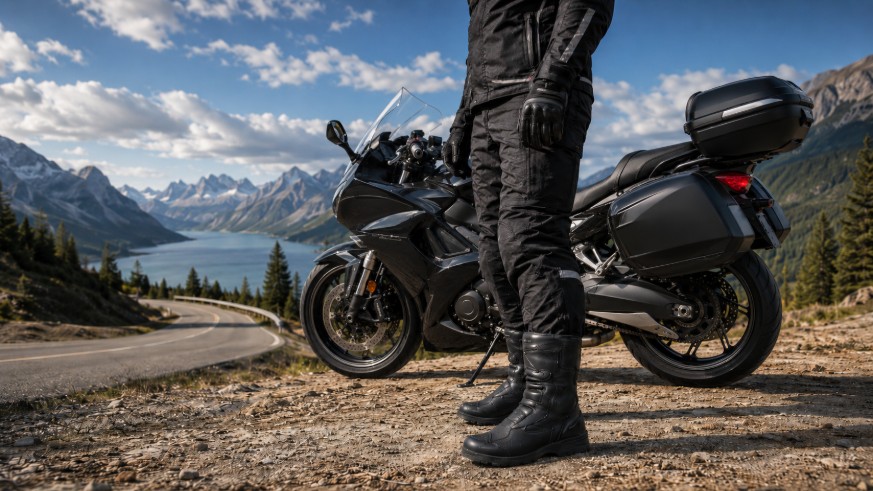
A strong sport touring boot balances protection, long-distance comfort, wet-weather performance, precise control feel, and enough walkability for routine stops.
The best sport touring boots strike that balance without compromising protection, and each major feature affects the others.
Ankle Protection Comes First
One of the main reasons to wear a true motorcycle boot instead of ordinary footwear is ankle protection. A sport touring rider may not need a full race boot, but the boot must still protect the ankle, heel, toe box, and shin.
Essential features include reinforced ankle zones, a structured heel cup, a reinforced toe box, and enough height to protect more than the foot alone. A short riding shoe may be comfortable, but for sport touring a mid-height or full-height boot remains the stronger starting point.
The boot must also resist twisting and crushing more effectively than casual footwear. That does not require the rigidity of a ski boot, but it does require enough structure to protect the foot and ankle if the motorcycle tips, the rider catches a rut, or a foot becomes trapped awkwardly.
Comfort Must Hold Up All Day
Protection, however, is only part of the equation. Sport touring boots must remain comfortable beyond the showroom, because pressure points, hot spots, and excessive stiffness become real distractions over a long day.
The best boots flex enough for natural shifting and braking while maintaining support. They must not pinch across the foot, rub the shin, or squeeze the ankle in the riding position.
Boots should be assessed in a riding posture, not just while standing. A boot that feels acceptable when upright can press on the shin or ankle once the knees are bent, so compatibility with peg position, shifter height, and preferred socks also matters.
Waterproofing Matters
Comfort alone is not enough if conditions deteriorate. For sport touring, waterproofing is more than a convenience, because long rides often cross changing conditions, and wet feet can turn an otherwise enjoyable day into a cold, distracting one.
A waterproof membrane such as GORE-TEX or a proprietary equivalent offers a substantial touring advantage. The best systems keep water out while allowing some breathability, even if no waterproof boot feels as airy as a summer mesh shoe.
The tradeoff is heat. Waterproof boots run warmer in slow traffic, so riders in very hot climates typically prefer a ventilated summer boot for local use and a waterproof touring boot for longer trips. In wetter regions, waterproofing is non-negotiable.
Grip Counts
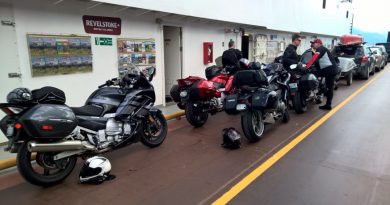
A sport touring boot also requires a practical sole. Minimal tread becomes a liability on wet pavement, gravel pullouts, ferry decks, gas-station concrete, or roadside shoulders.
A good touring sole provides grip without interfering with shifting. It must feel stable at stops and predictable when walking, especially with heavier motorcycles, loaded bikes, or two-up travel.
Walkability Still Matters
That practical focus extends beyond the footpegs. Sport touring includes substantial off-bike time at hotels, restaurants, overlooks, fuel stops, and ferry terminals, so a boot that performs well on the motorcycle but poorly on foot is ultimately the wrong choice.
Walkability does not mean giving up protection. It means enough flexibility, a stable sole, a comfortable interior, and a closure system that does not create pressure points.
Closure Systems Need to Work
That usability depends in part on how the boot closes. Boot closures vary widely, from zippers and hook-and-loop panels to buckles and BOA-style dial systems, but for sport touring the most important qualities are security, ease of use, and consistency.
A zipper-and-flap system is common on road-touring boots because it is quick and clean. Buckles provide more adjustability and protection, especially on adventure-oriented boots, but they add bulk. BOA-style systems allow fast, precise adjustment, though durability and field repairability still deserve consideration.
Whatever the system, it must stay secure while riding and remain easy to use at the start and end of a long day.
Boot Height Changes the Tradeoff
A taller boot generally offers more coverage and support, which is valuable for long-distance riding, loaded motorcycles, and occasional rough surfaces. A lower boot can be easier to walk in and more convenient for commuting, but it gives up protection.
Most sport touring riders are best served by a mid-height or full-height touring boot. Riders on rougher routes or heavier adventure-crossover machines often benefit from a more protective adventure-touring boot, while riders who remain primarily on pavement often benefit from a more flexible road-touring boot.
The Boot Has to Work with the Bike
Coverage and structure also affect how a boot works at the controls. Boots interact directly with the motorcycle, and a thick toe box can make shifting awkward, a bulky sole can dull feel at the controls, and a stiff ankle can make it harder to get under the shifter.
Before committing to a boot, riders need to consider whether the shift lever requires adjustment. That is common when moving from casual footwear or lightweight riding shoes to a more protective boot.
For sport touring, control feel matters. The boot must protect the rider without making the motorcycle feel clumsy.
Road Touring, Adventure Touring, or a Riding Shoe?
Those tradeoffs become clearer when the major boot categories are compared directly.
A road-touring boot is typically the best choice for riders who remain primarily on pavement and want waterproofing, comfort, clean styling, and everyday usability. An adventure-touring boot suits riders who regularly encounter gravel, unpaved roads, remote routes, or heavier crossover motorcycles. A short riding shoe can work for commuting or casual local rides, but it is rarely ideal for serious sport touring.
Because sport touring sits between performance riding and distance travel, the right boot combines protection, comfort, and weather readiness. From there, the core requirements are straightforward.
What a Sport Touring Boot Needs
A strong sport touring boot offers:
- Ankle protection and support
- Reinforced toe and heel areas
- A stable, grippy sole
- Waterproofing or serious weather resistance
- Enough flex for shifting and braking
- Comfort in the riding position
- Walkability for travel stops
- A secure closure system
- Compatibility with the motorcycle’s controls
No boot does everything perfectly. More protection usually adds bulk, more waterproofing reduces airflow, and more walkability often means less structure. The goal is to find the right compromise for the rider’s motorcycle, climate, mileage, and risk tolerance.
Product Examples to Consider
With those criteria in mind, the following examples show how different boots address the same sport touring demands. Product examples included here are intended to illustrate important points and tradeoffs, not to rank or endorse specific products. AmericanSportTouring.com receives no compensation for featuring these products and does not participate in affiliate marketing programs.
Example: Road-Touring Waterproof Comfort
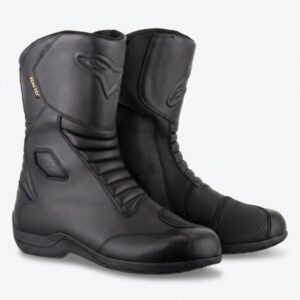
Alpinestars Web GORE-TEX Boots
The Alpinestars Web GORE-TEX represents the road-touring end of the category. The official product description emphasizes long-distance comfort, a waterproof and breathable GORE-TEX membrane, a side-entry system, reinforced toe-box construction, and CE-certified protective features.
In editorial terms, this is the classic road-touring formula: weather protection, straightforward entry, and enough structure for repeated paved-road mileage without the added bulk of a more off-road-oriented design.
Highlights: Road-touring waterproofing, easy entry, and long-distance comfort
Manufacturer: Alpinestars
Manufacturer page: Alpinestars Web GORE-TEX Boots
Example: Crossover Adventure-Touring Protection
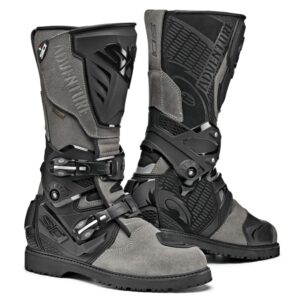
Sidi Adventure 2 Gore
The Sidi Adventure 2 Gore represents the more protective adventure-touring side of the segment. Sidi highlights a Flex System for controlled movement, a non-slip sole for grip and control, micro-adjustable buckles, and integrated protective features intended for more demanding terrain and extended travel.
For riders on taller crossover motorcycles or routes that include gravel and broken pavement, this type of boot makes a clear case for more coverage and support. The corresponding tradeoff is greater bulk, especially around the toe box, shin, and walking feel.
Highlights: Higher-coverage protection, off-pavement support, and rough-surface control
Manufacturer: Sidi
Manufacturer page: Sidi Adventure 2 Gore
Example: Mid-Cut Waterproof Versatility
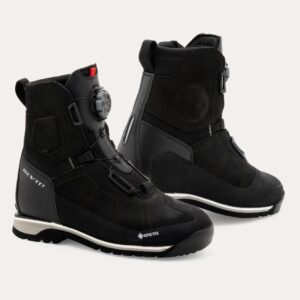
REV’IT! Pioneer GTX Boots
The REV’IT! Pioneer GTX illustrates the mid-cut waterproof approach. REV’IT! emphasizes a GORE-TEX laminate, a unibody construction intended to reduce seam pressure in flex areas, a Vibram Apex sole for grip and stability, a BOA fit system, and protective reinforcement at the heel, toes, and ankles.
In practical terms, this type of boot sits between a full-height touring boot and a heavier adventure model. It is the clearest example in this group of a design that prioritizes weather range and everyday usability without moving all the way to a tall, high-bulk chassis.
Highlights: Mid-cut waterproof versatility, lower bulk, and stronger off-bike usability
Manufacturer: REV’IT!
Manufacturer page: REV’IT! Pioneer GTX Boots
The Bottom Line
A great sport touring boot disappears into the ride, keeping the rider dry, supported, and comfortable for hours on the motorcycle.
The best choice is rarely the lightest or the most protective in absolute terms, but the one that best aligns with the rider’s actual use.
For sport touring riders, that means easier long days, fewer weather-related distractions, and surer footing at every stop.
Was this article helpful?
Thank you for your feedback!
Please email the editor with any additional comments.
Your feedback is used only by American Sport Touring. We do not store or sell your information.
Please read our Privacy Policy.